

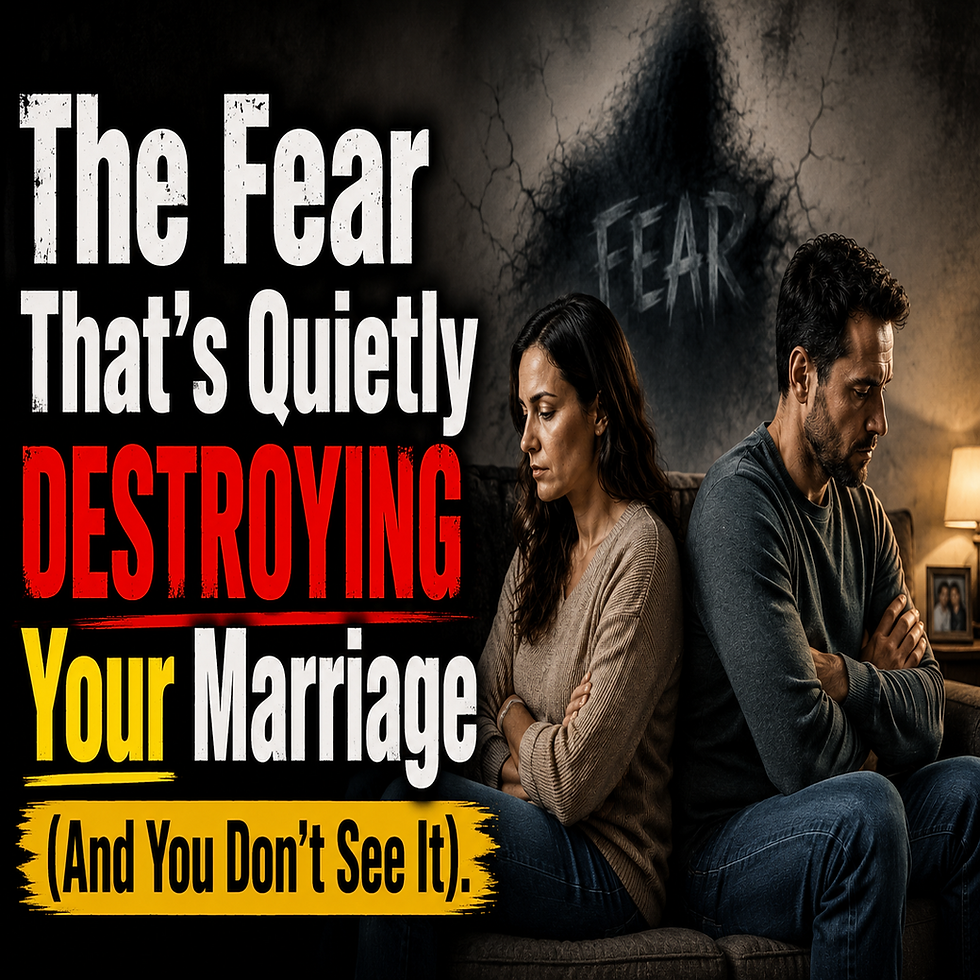
The Fear Quietly Running Your Marriage
Most couples think the biggest threats to marriage are things like money problems, communication issues, sex, parenting stress, or busy schedules. Those things absolutely matter, but underneath many of them is something deeper that often goes unnoticed for years: fear.
Fear rarely announces itself loudly in relationships. It usually disguises itself as wisdom, self-protection, or “keeping the peace.” It sounds like, “I don’t want to start a fight,” or “This isn’t a big enough deal to bring up.” It looks like silence, emotional shutdown, avoidance, overthinking, jealousy, people pleasing, or trying to control situations before they hurt you. The problem is that what feels like protection in the moment slowly creates distance over time.
One of the biggest lies couples believe is that avoiding problems keeps relationships healthy. In reality, avoidance often becomes the thing quietly damaging emotional intimacy the most. Research consistently shows that couples who avoid conflict experience lower relationship satisfaction and greater emotional disconnection over time. Silence may create temporary comfort, but it usually produces long-term loneliness.
Many marriages are not falling apart because couples do not love each other. They are struggling because fear is steering the relationship instead of love.
Fear of being alone is one of the most powerful forces in relationships. People assume this fear disappears once you get married, but that is not true. You can share a house, a bed, and a last name with someone and still feel emotionally isolated. Fear of being alone causes many couples to avoid difficult conversations because they are terrified of what honesty might uncover. Instead of addressing problems directly, they settle into survival mode. They become roommates instead of partners. They convince themselves that “at least we are still together,” while quietly losing connection year after year.
This fear also keeps people stuck in unhealthy patterns. Some stay emotionally disconnected because conflict feels riskier than distance. Others tolerate behavior they know is unhealthy because the idea of losing the relationship feels unbearable. The tragedy is that fear of losing connection often creates the very disconnection people were trying to avoid.
Another major fear driving marriages is fear of rejection. Rejection does not only happen in dramatic moments. It happens in everyday interactions. It can happen when your spouse is trying to connect emotionally and you stay glued to your phone. It happens when one spouse reaches for affection and the other seems uninterested. It happens when vulnerability is met with criticism, sarcasm, or indifference.
Over time, repeated rejection changes people. Research around rejection sensitivity shows that when people repeatedly feel dismissed or unwanted, they stop initiating connection altogether. They begin protecting themselves emotionally. They stop bringing things up. They stop flirting. They stop trying. Eventually, emotional intimacy and physical intimacy both begin to suffer.
This is why so many couples end up feeling stuck. One spouse feels abandoned because the other has shut down emotionally, while the other spouse feels exhausted from trying and failing to connect. What often looks like apathy on the outside is actually fear underneath. Fear says, “If I try again and get rejected again, it will hurt too much.”
Then there is fear of loss. This fear often shows up as control, insecurity, jealousy, or the constant need for reassurance. When people are afraid of losing their spouse, they sometimes respond by tightening their grip instead of deepening connection. They over-monitor. They overreact. They become suspicious. They seek control because control feels safer than trust.
The problem is that fear-based control slowly suffocates relationships. Healthy love requires honesty, trust, freedom, and communication. Fear-driven behavior creates tension and emotional exhaustion. Many couples do not realize that the behaviors pushing their spouse away are actually rooted in their own fear of abandonment or inadequacy.
One of the most damaging patterns researchers have identified in marriage is called the demand-withdraw cycle. One partner pushes for conversation, change, or emotional connection while the other withdraws, shuts down, or avoids the issue. The more one pursues, the more the other retreats. Over time, this creates resentment and hopelessness on both sides.
What makes this pattern dangerous is that both people usually believe they are protecting the relationship. The pursuer fears disconnection, while the withdrawer fears conflict or failure. Different behaviors, same root problem: fear.
This is where faith changes the conversation. Scripture reminds us in 2 Timothy 1:7 that God has not given us a spirit of fear. Fear may feel natural, but it was never meant to lead our lives or our marriages. Fear distorts communication, intimacy, and trust because fear is ultimately focused on self-protection. Love, however, moves toward honesty, sacrifice, vulnerability, and presence.
That is why 1 John 4:18 says that perfect love casts out fear. This does not mean healthy marriages never experience fear. It means love refuses to let fear sit in the driver’s seat.
The truth is that healing begins when couples are finally honest about what fear has been controlling them. Maybe you are afraid of conflict, so you avoid hard conversations. Maybe you are afraid of rejection, so you stopped initiating intimacy. Maybe you are afraid of abandonment, so you cling tighter and tighter to control. Whatever the fear is, you cannot heal what you refuse to confront.
A practical first step is simple but powerful. Identify one fear that has been shaping your behavior. Then identify the lie underneath it. Maybe the lie is, “If I bring this up, our marriage will fall apart.” Maybe it is, “If I let my guard down, I will get hurt again.” Maybe it is, “I have to control everything or I will lose them.”
Then replace that lie with truth. Healthy conflict does not destroy marriages; avoidance does. Vulnerability is risky, but emotional walls guarantee distance. Control cannot create intimacy because intimacy requires trust.
Finally, take one action that moves you toward honesty and connection this week. Have the conversation you have been avoiding. Apologize sincerely. Put the phone down and engage emotionally. Ask the hard question. Be honest about the hurt. Fear loses power when it is exposed.
The reality is that fear does not destroy marriages overnight. It slowly rewrites how couples communicate, connect, and show up for each other until distance becomes normal. But it does not have to stay that way.
Love can lead again. Honesty can return. Emotional intimacy can grow back. Communication can improve. Healing is possible when couples stop allowing fear to quietly control their relationship and start confronting it with truth, courage, and intentionality.
If this resonated with you, share this with another couple who may need encouragement today.
And if you are looking for more real conversations about marriage, intimacy, communication, conflict resolution, dating, Christianity, and relationship growth, make sure to follow the Married AF Podcast for more episodes and resources designed to help couples build stronger, healthier relationships.


Comments